
Your Field Team Shouldn't Have to Play Detective: Improving Field-to-Office Coordination in Construction
Construction superintendents and field teams have enough to manage without spending valuable time tracking down answers.
When an issue arises on a jobsite, the next step should be clear. But too often, getting a decision means figuring out who owns the issue, who has approval authority, and whether the right person has even received the information.
Effective field-to-office coordination in construction isn't just about communication. It's about creating clear paths for information, decisions, and accountability.
When Field-to-Office Communication Breaks Down
Imagine a superintendent identifies an issue in the field that requires clarification before work can continue.
The superintendent documents the issue, but several questions remain:
Who is responsible for reviewing it?
Who has the authority to approve the next step?
Has the issue already been escalated?
Was the appropriate person notified?
When can the field expect a response?
Without clear answers, the superintendent has two choices: stop and track down the information or continue working without a confirmed decision.
Neither option is ideal.
Waiting can affect schedules, crew productivity, and coordination with other trades. Moving forward without the necessary direction can introduce rework, additional costs, or project risk.
The issue isn't necessarily a lack of communication. It's often a lack of structure around how information moves between the field and the office.
Why Clear Decision Paths Matter in Construction
On complex construction projects, decisions rarely involve just one person.
An issue identified in the field may require input from a Project Manager, design consultant, subcontractor, owner, or another stakeholder.
Without a defined process, information can move through several conversations before reaching the person responsible for making a decision.
That creates opportunities for delays, missed notifications, and inconsistent documentation.
Strong field-to-office coordination establishes three important elements:
1. Clear Ownership
Every issue needs an identified person responsible for moving it forward. That doesn't necessarily mean they're the final decision-maker, but someone should be accountable for ensuring the issue reaches the appropriate party.
2. Defined Escalation Paths
When an issue cannot be resolved at the initial level, the next step should be understood. Teams should know when to escalate, who needs to be involved, and how urgent matters are prioritized.
3. Consistent Communication and Follow-Through
Once a decision is made, it needs to reach the people responsible for executing the work. Documentation, notifications, and follow-up help ensure information doesn't stop at the approval stage.
These elements help reduce uncertainty and create greater accountability throughout project execution.
Improving Field-to-Office Coordination Through Better Workflows
Improving communication doesn't always require adding another meeting, email, or software platform.
Sometimes the biggest opportunity is evaluating how existing workflows function.
Start by mapping how an issue moves through the organization.
Consider:
Where does the issue originate?
How is it documented?
Who receives the initial notification?
Who determines whether additional review is needed?
What happens when a response is delayed?
How is the final decision communicated back to the field?
Mapping these steps can reveal unnecessary handoffs, unclear responsibilities, or gaps in communication.
It can also help identify where technology and standardized procedures can support a more consistent process.
For example, a construction management platform such as Procore can help teams document RFIs, track correspondence, assign responsibilities, and maintain project records.
But technology alone doesn't establish an effective workflow.
The process still needs to define who is responsible, what action is required, and how information moves from one step to the next.
Connecting the Field and Office Through Operational Infrastructure
Field-to-office coordination is part of a larger operational challenge.
As construction organizations grow, projects become more complex, and teams manage more information across departments, informal communication methods can become difficult to maintain.
Processes that once worked through a quick phone call or conversation may no longer provide the visibility and consistency required across multiple projects.
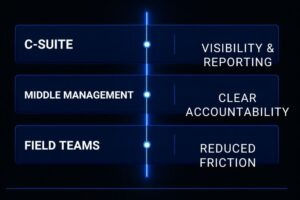
Establishing stronger operational infrastructure helps organizations create repeatable workflows that support both field execution and office oversight.
That can include:
Standardizing issue documentation and tracking.
Defining approval responsibilities and escalation procedures.
Improving notifications and follow-up expectations.
Establishing consistent workflows across projects.
Creating clear Standard Operating Procedures (SOPs).
Improving reporting and visibility into outstanding decisions.
The goal isn't to make every decision more complicated.
It's to remove unnecessary uncertainty so teams can spend less time determining what happens next.
How ZoKa Supports Better Field-to-Office Coordination
ZoKa Solutions works alongside construction organizations to strengthen the processes, systems, and operational infrastructure that support project execution.
Our team helps clients evaluate existing workflows, identify communication gaps, clarify responsibilities, and establish practical processes that improve coordination between field and office teams.
Depending on the organization's needs, that may involve workflow mapping, SOP development, project coordination, Procore optimization, or ongoing operational support.
The focus is on creating processes that work for the people using them, while improving visibility and accountability for those responsible for managing the project.
The Field Should Know Where the Issue Goes Next
A superintendent shouldn't have to understand the entire organizational structure behind every project decision.
They should know how to document an issue, where it needs to go, and when to expect a response.
And once a decision is made, the information should make its way back to the people responsible for executing the work.
Strong field-to-office coordination helps ensure the right information reaches the right people, decisions move through a clear process, and field teams can stay focused on building.
Is Your Field Team Spending Too Much Time Tracking Down Answers?
If your team regularly has to contact multiple people to determine who owns the next decision, it may be time to evaluate your workflow.
ZoKa Solutions helps construction organizations improve project coordination, clarify responsibilities, and establish processes that support more consistent execution. Learn more about ZoKa Solutions


Comments